

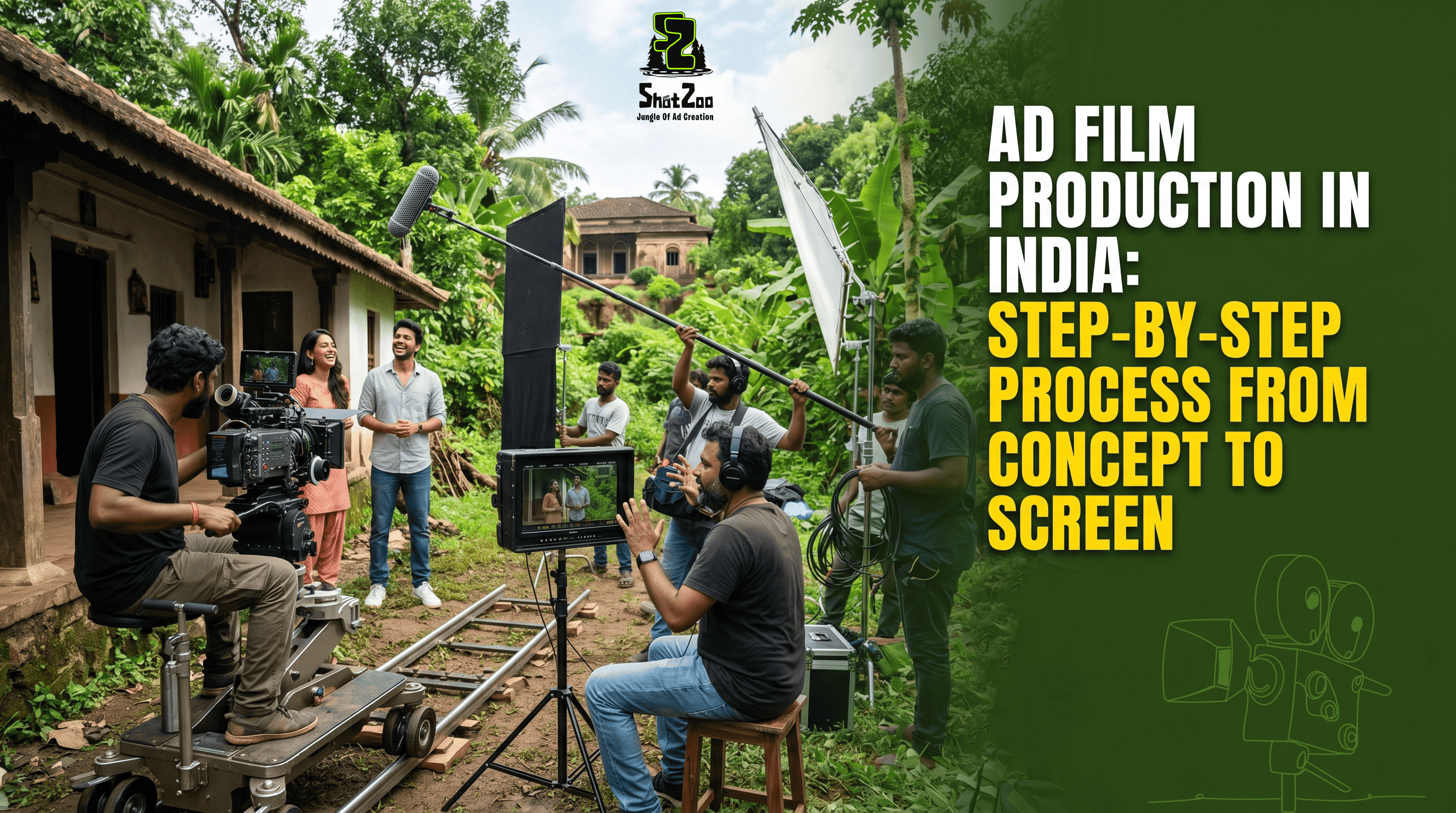
Ad Film Production in India: Step-by-Step Process from Concept to Screen
Updated by: Shotzoo Production Team
- Ad film production in India combines creative vision with technical mastery, taking a brand story from the spark of an idea to captivating commercials on television or digital platforms. Typically, the process covers concept ideation, script development, meticulous planning, casting, shooting, and post-production, all orchestrated by skilled professionals who shape the style and emotional impact of every frame.
- The commercial advertising film business is an intricate combination of artistry and an understanding of two very different worlds: One local (India) and one global (throughout the world). And as a result, Indian advertising film companies have transformed the whole production industry by making storytelling (creating) a powerful tool to connect customers with new-age (modern) products/brands through highly creative cinematic films.
Understanding Ad Film Production in India
- To many, Indian advertising films are snazzy, vibrant commercials that appear everywhere from YouTube pre-rolls to cricket matches, but the reality of creating an ad film in India is a whole different story. Ad film production in India entails an incredibly complex process in which creative ideas compete for attention and cultural context plays a major role in each and every shot. Innovation and tradition intersect in India’s ad film production industry.
- Every ad project is brought to life through collaboration between creatives, technical specialists, and business-minded individuals, resulting in advertisements that are designed to sell products but also tell stories that will remain in people’s memories, even among the very diverse population of India.
- Indian ad film production has adapted to the evolving viewing habits and regional preferences of contemporary audiences, while at the same time trying to maintain quality comparable to worldwide advertisements. Advertisers demand products that can be viewed with equal comfort on both cinema screens and mobile devices, and the industry has responded by developing a large pool of talent from established directors to emerging editors, all of whom are adjusted to the rapidly evolving media landscape of India.
- If Indian ad films are able to achieve their full potential, the result will be a hybrid of entertainment value and an effective call to action that resonates distinctly on a local level.
The Indian Ad Film Industry: Overview and Trends
- As we move ahead in time, we can see that the Indian advertising industry has changed significantly over the last few decades. The transition from basic slogans and simple jingles during the 1980s to sophisticated, high-quality visuals, dramatic storytelling and a technological polish characterizes the current state of the Indian advertising industry.
- Film production companies in India don’t just create Television Commercials anymore; they also develop brand narratives through creative ad film production and integrated advertising video production services for digital, social media, and OTT platforms.
- Today, the commercial production ecosystem in India responds rapidly to a fragmented audience. Top ad film production houses in India are now routinely creating content in several languages, adapting messages for regional tastes and developing creative ways to communicate their brands. In recent years, the demand for microstories (such as 6-second bumpers, Instagram reels and Youtube ads) has increased drastically. But the core fundamentals of Indian ad film production have not changed.
- The best advertisements still rely on the classic three ingredients—the memorable Hook, the Technical Excellence, and the Emotional “Aha!” moment. These factors help people say, “Did you see that new advertisement?”
Key Steps in India Ad Film Production
Concept Development and Ideation
- Every advertisement film begins with a spark—the concept must be both timely and resonate well. In India, the ideation process usually takes place within creative workshops where teams can share ideas, finalize the brand’s message, and shuffle through discussions on the emotional tone for the ad.
- There will always be someone asking, “Does this work for both Mumbai and Madurai?” which is often impossible to answer without local knowledge and insight, which has proven to be worth its weight in gold—simply because the best advertisements discover universal truths inside each day-to-day scene, such as a crowded train, the warmth of a festival, or the sound of clinking chai glasses.
- Brands who work together with Shotzoo generally create emotion-based storytelling in order to build brand recognition across the many unique Indian audiences.
- Brand brief → Identify message and audience
- Research → Explore trends, culture, and competition
- Brainstorm concepts → Select creative direction
- Some of India’s most well-known advertisements share a similar history: they began as drawings on a whiteboard, which were then transformed into actual advertisements during the initial stages of production; this process also helps establish the future collaborative efforts between the agency and clients.
Scriptwriting and Storyboarding
- Being both an art and a process of negotiation, writing for scripts involves writing lines that must express a great deal of information in 15–40 seconds or perhaps even fewer. It then moves into storyboards that contain little sketches that illustrate what each shot will look like as the production of advertising films takes place.
- The storyboards that directors, cinematographers, and brand managers in India use for advertising film production are not merely rough sketches but detailed blueprints that allow them to see the film without needing to shoot it.
- The use of great storyboards can prevent mistakes, provide cost control, and guarantee a smooth transition from one part of the film to another. According to many experienced advertising film directors in India, “If it’s not going to work on paper, it’s not going to work on screen.” Another major part of the TV commercial production process is visual planning; it has a direct correlation to the effectiveness of the commercial campaign.
Pre-Production Planning
- Success in ad film production in India is based primarily on preparation rather than luck; pre-production is when logistical considerations are integrated with creative ideas (such as scheduling, finding filming locations, determining wardrobe selection, obtaining permission, and developing budgets).
- Additionally, technical feasibility issues arise during this stage: Can you shoot a drone over Marine Drive during rush hour? Will your rain machine work when it is 40 degrees Celsius outside?
- A methodical pre-production phase helps keep costs in check and execution on track. Ad agencies in India commonly have contingency plans established for each aspect of production—from inclement weather conditions to traffic jams—that include unpredictable elements that characterize this industry, thus allowing ad filmmakers to continue producing despite potential setbacks. An experienced company for ad shoot production ensures seamless coordination during every stage of production planning.
Casting and Crew Selection in Indian Ad Film Production
- This stage creates the faces and voices of advertisements. There has been a shift away from the historically preferred use of celebrity faces in Indian advertising to a more complex combination of character actors, new talent, and sporadic superstar appearances since the casting in Indian advertising has evolved. The decision to use a regional influencer can drastically change how an advertisement or company promotes itself.
- As such, choosing the right production team is critical. The teams that build Indian advertising films consist of highly specialized professionals who work closely together to produce high-quality results. These professionals include directors who have an instinctive understanding of product categories, cinematographers who speak fluently about light, and hairstylists and makeup artists who have a thorough understanding of urban and rural fashion trends.
- The gaffers who work on the productions understand how to continue with minimal interruption in case of an electrical failure and to help keep the work environment running smoothly.
- The majority of production staff engage in teamwork; all staff members operate based on the understanding that, if one person makes a mistake, the rest of the crew will likely lose time from their project due to a need for additional filming. With the right combination of experience and familiarity with each other’s work styles, production teams that are forced to complete a project on a limited timeline or under adverse conditions can turn these situations into moments of innovation.
Shooting the Ad Film: On-Set Production Process
- There are typically two parts to a filming day: anticipation & organized chaos. We have buzzing lights, dangling mics & a director cutting every scene down to how high an actor raises their eyebrow. Ad Film shoots in India vary widely, from a digital campaign shooting in one day with no budget to elaborate films shot in cities or villages.
- Many corporations have developed their ad Films primarily for digital storytelling in order to maximize audience interaction across multiple platforms. Filming is generally about flexibility; a production could begin at daybreak, shooting on a busy road, then move to a leafy cafe for “golden hour” light, and finally to sound engineering to capture the sound of a crunchy samosa being eaten.
- There are also many surprises that can happen during filming, such as unexpected rain or a cow wandering onto the set. This is where good communication and creativity will definitely help the director, line producer, assistants, and crew to coordinate their efforts to deliver the intended vision despite whatever happens throughout the course of the day.
Post-Production Workflow for Ad Films in India
Editing and Visual Effects
- The magic of the raw footage is created by the post-production processes. In Indian advertising companies, film editors will edit footage to the beat of the dialogue/script, add transitions, modify the color, and sometimes have visual effects created. Editors have reported it as being a combination of instinctual and technical abilities to create a viable product from the hundreds of hours of raw footage they are given to create a punchy story that flows together.
- With clients wanting everything turned around almost immediately, the top post-production companies are able to work extremely fast, but never at the expense of the clarity of the story or the impact of the brand. As brands evolve, companies that provide brand video production services in India are continuing to invest in state-of-the-art editing solutions in addition to filmmaking and finishing options.
- Visual Effects create a more contemporary and professional appearance in advertisements. More and more production houses in India have begun to invest in the latest technology such as VFX software and employ VFX professionals to meet or exceed global benchmarks for advertising.
Sound Design and Final Output
- Sound can provide a reasonable advertisement; however, it may be made memorable by its use of sound to elicit a reaction or feeling from the viewer. Sound designers in India have learned how to create emotional responses through music and sound effects based on things that are commonly found in India, such as the ringing of currency, the sounds of drums, and soft sounds of a monsoon evening.
- Companies will use quality voiceover and articulate lip-syncing with the dubbed version of the site, as well as proper balances between each, to create the best possible outcome for the sound in the advertisement.
- Using multiple channels of communication, the last mile will be able to essentially eliminate the differences in quality between it being outputted on a high-definition Television and an uploaded video on YouTube Mobile.
- The companies that produce advertisement films for the Indian market know how to optimize both sound and image for different channels (for example, some will produce multiple outputs based upon what channel will be used for viewing, the audience demographics, and/or the language the advertisement was created in).
Top Ad Film Production Houses in India
- You can find many of the same companies repeatedly listed when looking for the top ten advertisement film production companies in India. For instance, GoodFellas Studios is engaged in all areas of storytelling (i.e., celebrity, technology, fast-moving consumer goods, and digital-first), while Advista Films has cemented its place as an innovator of beautiful, entertaining, and impactful advertisements in the Indian marketplace for urbanites and the digitally minded.
- Newer companies like Shotzoo are also emerging on the radar as modern-day advertisement film production companies, creating visually stimulating campaigns for several verticals of business. Other regional companies such as Filmy Ads and Pathway Productions from Chennai help shape the industry, adjusting their understanding of local market conditions and languages; they frequently develop content for both traditional media and digital media.
- While most of these companies operate in Mumbai, a growing number are rapidly expanding in Chennai and New Delhi.
Notable Ad Film Directors in India
- Selecting the correct director is probably the most important factor when it comes to producing commercial advertisements. In India, unique characteristics and styles of Indian commercial directors include using compelling visuals and strong emotional connections to their target markets. Ayub Shah from Advista Films has become one of the best visual storytellers in the country and has earned a reputation for creating some of the most impactful commercials in India.
- Furthermore, many other commercial film directors have developed their own unique styles based upon their ability to use humor creatively, storytelling that reflects regional culture, or technical innovations in commercial filmmaking.
- The most respected and successful commercial film directors in India have the ability to create what are considered ‘mini-stories’ out of a standard 30-second television commercial and leave an enduring memory with the viewers, thus proving that commercial filmmaking is both an art as well as a business.
What are the stages of ad film production in India?
- Concept development and ideation
- Scriptwriting and storyboarding
- Pre-production planning
- Casting and assembling the crew
- Shooting/on-set production
- Post-production—editing, sound, final mastering
This staged workflow helps convert a raw idea into a finished film ready for public screening.
Frequently Asked Questions About Ad Film Production India
The ad film industry in India refers to all companies, professionals, and creative teams involved in making filmed advertisements for TV, web, and OTT platforms. These projects range from cinematic TV commercials and digital ads to branded content, all designed for the Indian market’s linguistic and cultural diversity.
Costs for producing ad films in India vary based on factors like script complexity, talent, location, equipment, and post-production. For a 30-second commercial, budgets can start from a few lakh rupees and go up to crores for top-tier campaigns—especially with celebrities or elaborate sets. Expect digital-only or animated films to fall at the lower end, while TVCs and multi-location shoots command higher prices.
Seek a company with a proven industry track record, a strong creative team, and the ability to execute within prescribed timeframes and budgets. It helps to review past campaigns, check testimonials, and see if their aesthetic matches your brand vision. Collaboration style and responsiveness matter—a good team guides you clearly through the process and works with your feedback.
In 2026, leading names include GoodFellas Studio, Advista Films, Filmy Ads, and Pathway Productions. These companies consistently produce high-profile campaigns, balancing large budgets and creative demands while meeting timelines for both traditional and digital media platforms.
Conclusion: Navigating Ad Film Production in India
- What all successful Indian ad film productions have in common is culture awareness, tech-savvy production techniques and creative business strategy, all taking place within a very fluid industry that changes in direct correlation to shifting public opinion.
- Well-crafted ad films allow for brands and agencies to rise above the clutter of competition through visual impact, emotional appeal, and building trust within an overcrowded marketplace; the process from conceptualizing an idea to final production takes a combination of creativity as well as discipline.
- As society continues to become more fragmented and people’s attention spans continue to shorten, Indian ad film production will need to continue evolving to be more clever about how to connect consumers and ensure that brands remain memorable. For anyone interested in breaking into this space, my recommendations would be to watch, listen, and learn from highly successful professionals within this sector, continually reminding yourself that the next big idea in Indian commercials is just around the corner.
- If you want to elevate your brand’s storytelling with quality commercial ad film production, then consider partnering with Shotzoo, as they can help create memorable campaigns that resonate with your audience. From concept development to final delivery, Shotzoo provides end-to-end advertising video production services tailored for modern brands. Start your ad film journey today and transform your vision into a compelling visual campaign that drives engagement and brand recognition.